Showing posts with label awake. Show all posts

Wednesday, December 13, 2017

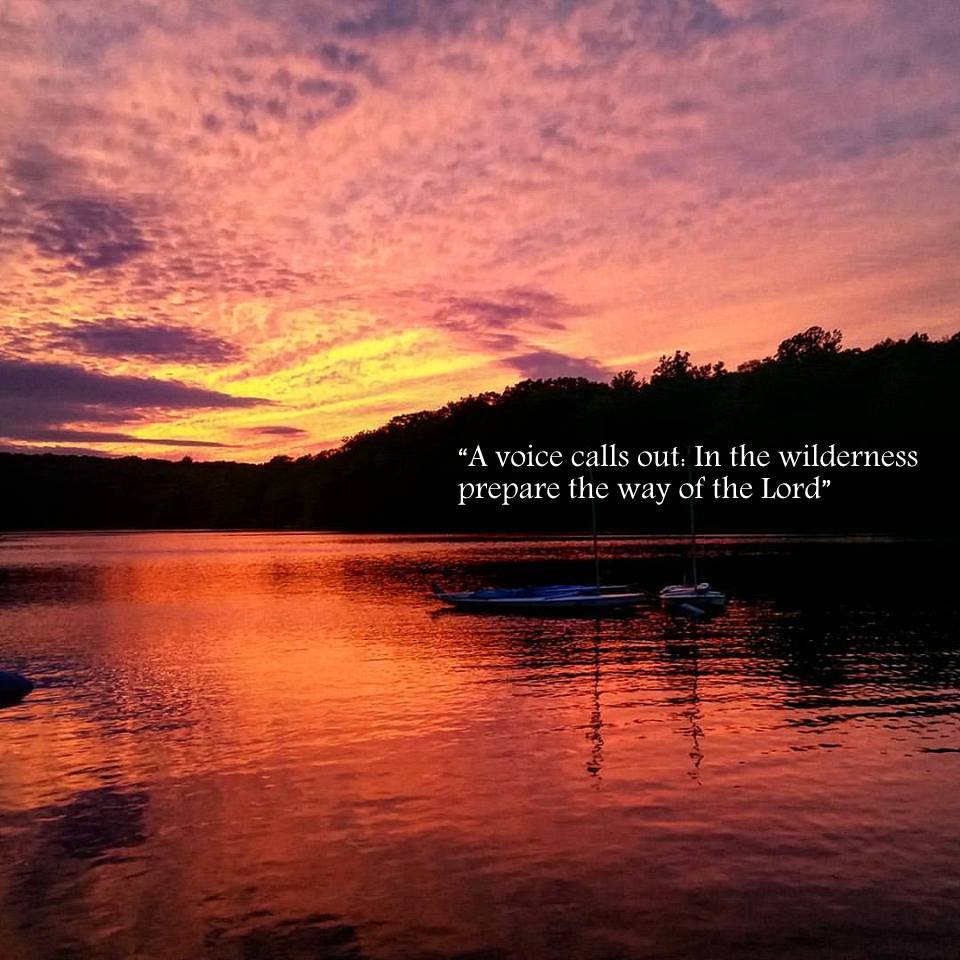
“A voice calls out: In the wilderness prepare the way of the Lord”

In our Gospel reading from this past Sunday (Mark 1: 1-8) we encounter John the Baptist in the wilderness. This is where it begins, we are told. The wilderness. A space set apart from the hustle and bustle. Just a few lines later in Mark’s Gospel, Jesus travels from Nazareth to be baptized by this wild prophet who wears camel’s hair and eats locusts and wild honey.

Before he can begin his ministry of loving the world, Jesus too goes to the wilderness. And during his time in this space set apart Jesus sorts out what his ministry will be. It is in the wilderness that Jesus comes to understand what matters most, what God is calling him to and who he is.

While listening to the readings this past weekend, I couldn’t help but be reminded words from Trappist Monk and Catholic writer Thomas Merton:

“…there is a pervasive form of contemporary violence… activism and overwork. The rush and pressure of modern life are a form, perhaps the most common form, of its innate violence. To allow oneself to be carried away by a multitude of conflicting concerns, to surrender to too many demands, to commit oneself to too many projects, to want to help everyone in everything is to succumb to violence. More than that, it is cooperation in violence. The frenzy of the activist neutralizes [their] work for peace. It destroys [their] own inner capacity for peace. It destroys the fruitfulness of [their] own work, because it kills the root of inner wisdom which makes work fruitful.”*

Merton’s words remind me that allowing myself the time to retreat from the hubbub of the world and instead follow the voice of God into the wilderness is so important. I know that without making this space, it is so easy to get caught up in the all-consuming frenzy and violence of overwork.

It is in this space set apart where we can more fully connect with God, with ourselves and with one another. In the wilderness we listen to the voice of the still speaking God. We are then able to to reenter the world recharged, reconnected and reinvigorated in mind, body and spirit to live faithfully. We are better able to stay awake to Christ’s presence in our lives and to lend our own voices to the work of love and justice that Christ calls us to.
Post by Dana Capasso Stivers
 
*Thomas Merton, Conjectures of a Guilty Bystander, Page. 81

*Photo is Dana’s

Thursday, December 7, 2017

Preparation

Embed from Getty Images

In the Eucharistic readings for the Feast of St. Ambrose (today, December 7), we hear Christ instructing his disciples to “Be dressed for action, and have your lamps lit; be like those who are waiting for their master to return from the wedding banquet, so that they may open the door for him as soon as he comes and knocks” (Luke 12:35). This echoes a familiar refrain from the past few days and weeks. Keep awake! Be ready! You do not know the hour when the master will return!

In this season, it can sometimes seem like there are too many things to get ready for. As Christmas approaches, many experience the pressure of putting on the perfect holiday gathering for family or friends, or of getting just the right gifts for everyone.  Others feel the seasonal weight of lengthening nights, or an impending loneliness as they look towards a Christmas apart from their loved ones.  Students may be busy preparing for final exams, or looking forward to the college application season or the job market, with all the uncertainty these provide.  Add to that the news of a world so baffling that it’s anybody’s guess how best to be prepared for what may come… It adds up.  It takes its toll.

And yet here we are, at the beginning of Advent, called by Christ to keep awake, to be ready, to be dressed for action. With all the hubbub and bustle of our lives in December, how on earth are we supposed to do that?

Another of the readings appointed for today’s feast gives us an answer:

            You who fear the Lord, wait for his mercy;
                        do not stray, or else you may fall.
            You who fear the Lord, trust in him,
                        and your reward will not be lost.
            You who fear the Lord, hope for good things,
                        for lasting joy and mercy.
                                    (Ecclesiasticus 2:7-9)


Wait, trust, hope.  To be prepared for Christ is to trust God, to hear the Good News that in God we will find joy and mercy.  When the world expects us to be always busy, to be always on the go, it’s happy news indeed that in Christ, to be ready may simply mean to pause, to wait, to understand that our hope is in God’s saving grace and not in our own hectic preparations.  Have your lamps lit, yes, but remember who it is who gives us the fuel for those lamps.

Post by Jett McAllister

Monday, December 4, 2017

Keep Awake


I lie down and sleep;
I wake again, for the Lord sustains me. (Ps. 3:5)
In our gospel lesson yesterday, we find one of the recurring themes associated with the season of Advent: “Keep awake—for you do not know when the master of the house will come, in the evening, or at midnight, or at cockcrow, or at dawn, or else he may find you asleep when he comes suddenly” (Mk. 13:35-36). Monastic communities have long taken these words to heart. No liturgy exemplifies this as much as Matins, with its twelve psalms and three to twelve readings daily, recited in vigils throughout the night.
For those of us who haven’t devoted ourselves to the same monastic rigor, however, the command to stay alert exists in some tension with the positive qualities that scripture applies to sleep. Even monastic communities seem to have understood that tension. The daily office is bookended by Psalm 4, recited at the end of the day, “I lie down in peace; at once I fall asleep; for only you, Lord, make me dwell in safety,” and Psalm 3, recited at its beginning, “I wake again, for the Lord sustains me.”
How might we, then, “keep awake” even as we honor the other important commitments in life that demand our time and energy? For one, we can start with cultivating a habit of prayer throughout the day. Now, that doesn’t mean we have to start chanting dozens of psalms or reading books of the Bible every day—though, of course, grace and peace to those who can. But it does mean something as simple as reciting the words of the psalmist: “I remember you upon my bed, and meditate on you in the night watches” (Ps. 63:6). It means something as simple as waking up and telling ourselves and others “of God’s loving-kindness early in the morning” and preparing for sleeping and talking “of God’s faithfulness in the night season” (Ps. 92:2). And for those of us who are struggling right now and who want to see God’s mercy and faithfulness in our lives, it may mean something like starting with “early in the morning I make my appeal and watch for you” (Ps. 5:3) and then offering our petitions to God through Christ.
The second way we can “keep awake” is to live intentionally throughout the day. It’s one thing to start and end our days with God on our lips. It’s another to have God before our eyes as we walk about the world. Jeremy Taylor, a 17th-century Anglican bishop, offers this advice: “Begin every action in the name of the Father, of the Son, and of the Holy Ghost” and “let every action … be begun with prayer.” In everything, Taylor calls us to consider that our actions—even the most mundane and “common action of our life”—may in fact be “the work of God” (Holy Living, I.II). This may seem excessive, but however we do it, devoting ourselves wholly to God will transform our souls so that we may find ourselves growing into the full stature of Christ and thus find ourselves described in the words of our psalm from this morning:
They are like trees planted by streams of water,
bearing fruit in due season, with leaves that do not wither;
everything they do shall prosper. (Ps. 1:3)
Post by Armando Ghinaglia

--
For the full text of Taylor’s Holy Living, see here: http://www.anglicanlibrary.org/taylor/holyliving/index.htm
The language is complicated and not gender neutral, unfortunately, but the text is a classic in Anglican spirituality.

--

Photo labeled for reuse with modification from: https://static.pexels.com/photos/289772/pexels-photo-289772.jpeg